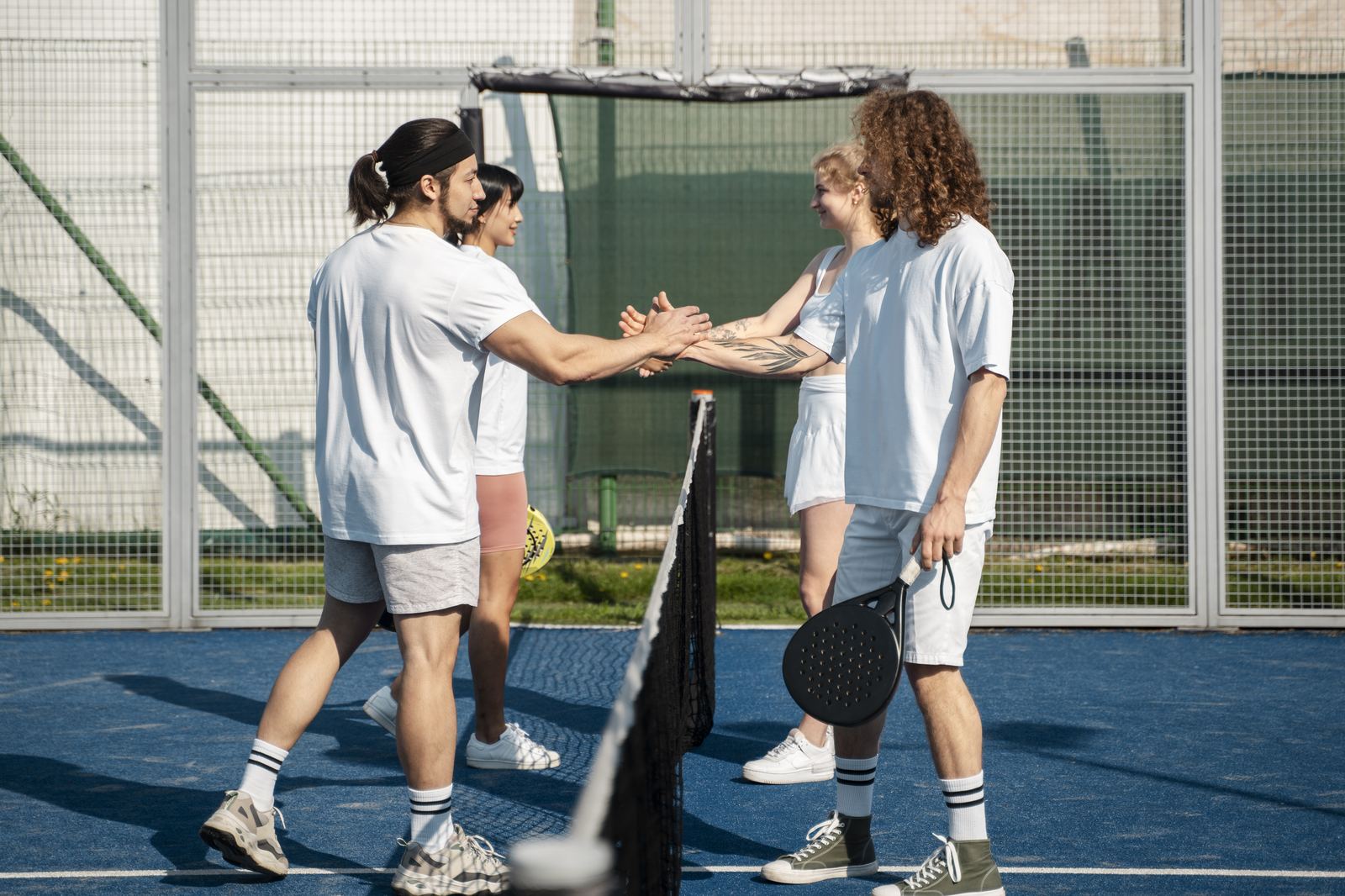
In the United States, three racquet sports get constantly confused with each other — usually by well-meaning friends who ask me how my "pickleball tournament" went. Padel, pickleball and paddle tennis are three genuinely different sports with different courts, different equipment and, honestly, different personalities. Having played all three (one of them far more than the others), here is the clearest comparison I can offer.
Padel: the glass-court game
Padel was invented in Acapulco, Mexico in 1969 by Enrique Corcuera, then exploded in Spain and Argentina before spreading worldwide. It is played in doubles on a 20-by-10-meter court enclosed in glass and mesh. The walls are in play after the bounce — think tennis crossed with squash. Scoring is tennis scoring; the serve is underhand; rackets are solid and perforated with a foam core; the ball is a slightly depressurized tennis ball. Globally, padel is the giant of the three, with tens of millions of players concentrated in Spain, Latin America and, increasingly, the Middle East and the United States. Rallies are long, geometry matters more than power, and the doubles format makes it relentlessly social.
Pickleball: America's phenomenon
Pickleball was invented in 1965 on Bainbridge Island, Washington, and it is the sport that actually conquered America first. It is played on a badminton-sized court (20 by 44 feet, no walls) with flat solid paddles and a perforated plastic ball. Serving is underhand, scoring traditionally runs to 11 points, and the "kitchen" — a no-volley zone at the net — defines the tactics. Pickleball's genius is its gentle learning curve and tiny footprint: four courts fit where one tennis court stood, which is exactly how it colonized parks and community centers across the country. It is easier on the body than padel, quicker to learn, and its player base in the US dwarfs every other racquet sport's.
Paddle tennis (and its cousins)
Here is where the naming chaos peaks. "Paddle tennis" historically refers to an American sport played on a smaller tennis-style court with a solid paddle and a depressurized tennis ball — no walls in the classic version. It has been rebranded in recent years as POP Tennis. Meanwhile, the northeastern US plays platform tennis (often just called "paddle" in country-club circles): a winter sport on a small raised court with heated decks and taut chicken-wire screens that keep the ball in play, a distant structural cousin of padel. When someone from New England says they play "paddle," they usually mean platform tennis. When a Californian of a certain generation says it, they may mean POP tennis. Neither is padel.
Quick comparison
- Court: padel 66x33 ft with glass walls; pickleball 44x20 ft, no walls; platform tennis 44x20 ft raised, with screens.
- Ball: padel, low-pressure tennis ball; pickleball, plastic with holes; paddle/platform, spongy or depressurized rubber.
- Serve: underhand in all three — but only padel plays walls off a glass enclosure.
- Scoring: padel uses tennis scoring; pickleball games to 11; platform tennis uses tennis scoring.
- Format: padel and platform tennis are doubles-first; pickleball plays both.
Which one is for you?
An honest guide, free of tribal loyalty — almost:
- Choose pickleball if you want the lowest barrier to entry, the shortest path to a nearby court, and a game you can play with three generations of your family this weekend. Availability in the US is unbeatable.
- Choose padel if you come from tennis or squash, if long tactical rallies excite you more than quick exchanges, and if you want a sport you can grow into for a decade. The glass changes everything: defense becomes an art, and no lead feels safe.
- Choose platform tennis if you live in the Northeast and want a reason to be outdoors hitting a ball in January. It is the only racquet sport that improves in the snow.
Can skills transfer?
Substantially. Tennis players adapt to padel fastest — the scoring, the net play and the swing shapes carry over, though they must unlearn the big backswing (the glass punishes it). Pickleball players arrive with soft hands and net instincts, both gold in padel. Going the other way, padel players tend to find pickleball's kitchen game intuitive. The sports are rivals only in headlines; in practice, most multi-racquet athletes I know in South Florida play at least two of them happily.
The South Florida angle
Down here, the question is not either/or. The newest clubs — including Boca Raton's upcoming Boca Paddle by CityPickle — are built for padel and pickleball under one roof, betting that the two booms reinforce each other. From what I see on the courts every week, they are right.